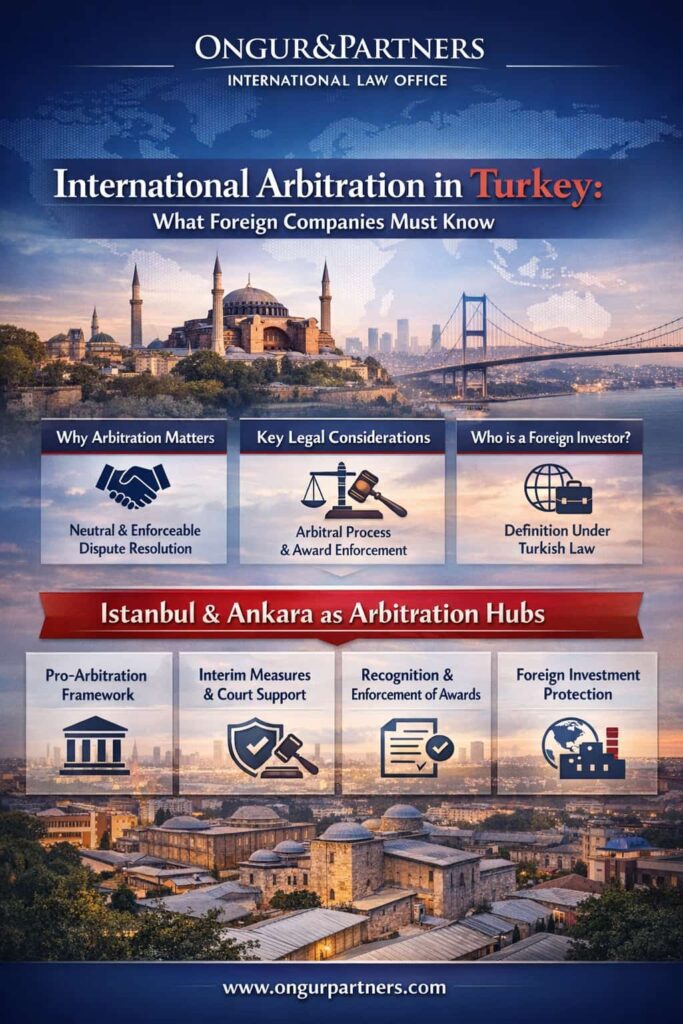
International Arbitration in Turkey. For foreign companies entering the Turkish market, dispute resolution is not a secondary contractual issue. It is one of the central legal considerations shaping investment strategy, project structuring, risk allocation, and long-term enforceability. In Turkey, and particularly in commercially significant centers such as Istanbul and Ankara, international arbitration has become one of the most important mechanisms through which foreign investors seek neutrality, predictability, and enforceability in cross-border disputes. The article you uploaded emphasizes that when foreign investors assess whether to invest in a given jurisdiction, the availability of international commercial arbitration and the treatment of foreign arbitral awards in that jurisdiction can materially influence the investment decision.
That observation remains highly relevant in the Turkish context. Foreign companies rarely focus solely on the possibility of an arbitral tribunal hearing a dispute. They also want to know whether Turkish law permits arbitration for the type of transaction at issue, whether local courts may interfere with the arbitral process, whether interim protection is available when urgency arises, and whether an eventual award can be recognized and enforced without excessive procedural difficulty. The Turkish framework discussed in the source article addresses precisely these questions and presents a legal landscape that has, over the last decades, developed in a distinctly pro-arbitration direction.
Why Arbitration Matters to Foreign Investors in Turkey
International arbitration has long been regarded as the preferred dispute settlement mechanism for international commercial disputes, particularly where foreign investors are involved. The source article expressly links the encouragement and legal protection of foreign investment to the existence of a functioning international arbitration system. It also explains that investors do not evaluate arbitration in the abstract; rather, they focus on whether the host state’s legal system allows meaningful arbitration and whether arbitral awards can later be recognized and enforced there.
This is especially important in Turkey, where foreign investment frequently intersects with infrastructure, energy, construction, finance, and regulated commercial activity. In these sectors, the need for a neutral forum can become acute. A foreign company may be unwilling to submit a large-value dispute solely to the domestic courts of the host state, especially where the contract is long term, technically complex, or politically sensitive. Arbitration responds to that concern by allowing the parties to choose a neutral seat, define the applicable procedure, select decision-makers with specialist expertise, and rely on an enforcement regime supported by international conventions.
For businesses operating from or through Istanbul and Ankara, this has practical implications. Istanbul is the natural commercial gateway for many international transactions involving Turkey, while Ankara remains indispensable in matters touching regulatory authorities, public contracts, administrative decision-making, and investment structures with a public-law dimension. A foreign investor’s arbitration strategy therefore often requires not only knowledge of international standards, but also a close understanding of how Turkish law operates in practice across these two major centers.
Who Qualifies as a Foreign Investor Under Turkish Law
Under the Foreign Direct Investment Act of 2003, a foreign investor includes both real persons of foreign nationality and Turkish nationals resident abroad, as well as foreign legal entities established under foreign law and international institutions that make direct foreign investment in Turkey. The same statute defines foreign direct investment broadly, including the establishment of a new company or branch in Turkey and certain share acquisitions, as well as the use of assets such as foreign currency capital, machinery, equipment, industrial and intellectual property rights, reinvested earnings, and certain commercial rights relating to natural resources.
This framework is important because it shows that Turkish investment law does not treat foreign investment narrowly. On the contrary, it recognizes a wide range of transactional forms through which foreign capital may enter the country. For foreign companies, that breadth matters because access to arbitration protections often depends on how the relevant investment is characterized under domestic legislation, bilateral investment treaties, or sector-specific regulatory arrangements. The article also notes that international agreements may contain their own definitions of investor and investment, which means that any arbitration analysis involving Turkey must account not only for Turkish domestic law, but also for the treaty framework potentially applicable to the transaction.
The Turkish Legal Framework for International Arbitration
To identify, Turkey’s domestic legislative framework as a combination of the International Arbitration Act, the International Private and Procedural Act, the Foreign Direct Investment Act, and the case law of the Court of Cassation. Among these, the Turkish International Arbitration Act is presented as the central legislative milestone. Adopted in 2001, it was designed specifically to regulate international arbitration and to modernize Turkey’s approach in a way that would support foreign trade, foreign investment, and international commercial activity.[3]
Turkish International Arbitration Act is based on the 1985 UNCITRAL Model Law, even though certain differences remain. That legislative choice is highly significant for foreign companies. It means that the architecture of arbitration in Turkey was consciously aligned with a widely accepted international template rather than left to fragmented local procedural doctrine. The article characterizes the enactment of the statute as a milestone in Turkey’s arbitration development and explains that one of its express objectives was to liberalize the legal environment, make Turkey more attractive as an arbitration venue, and encourage international business relations and foreign participation in major projects.
The Act applies to disputes containing a foreign element where Turkey is chosen as the seat of arbitration, or where the parties, the arbitrator, or the arbitral tribunal have elected to apply the statute. The concept of “foreign element” is described in broad terms. It includes, among other scenarios, cases where the parties’ places of business are in different states, where performance or the closest connection lies in another state, where foreign capital has been introduced into the transaction, or where the contract involves a transfer of capital or goods from one country to another. For foreign companies, this breadth is advantageous. It reduces the likelihood that a transaction with obvious international features will fall outside the intended scope of the international arbitration regime.
Under the Act, the parties may choose the language of the proceedings, determine the rules of procedure, and even adopt international or institutional arbitration rules. They may also choose the substantive law governing the merits of the dispute. If they fail to do so, the law of the state with the closest connection will apply. From a drafting perspective, this is one of the most important aspects of arbitration in Turkey. It confirms that foreign companies can structure dispute resolution clauses in a way that reflects commercial expectations rather than merely defaulting to rigid domestic procedure.
The Importance of the Foreign Direct Investment Act
In this article, we give special attention to the Foreign Direct Investment Act and rightly so. Beyond defining foreign investors and foreign direct investment, the statute contains an express provision on dispute settlement. Article 3(e), as reproduced in the article, states that disputes arising from private-law investment agreements and public service concession agreements concluded with foreign investors may, subject to the applicable conditions and party agreement, be brought before local courts, national arbitration, international arbitration, or other dispute settlement mechanisms.
This provision is especially important for foreign companies because it reflects a deliberate legislative acceptance of international arbitration as a legitimate and available method of resolving investment-related disputes in Turkey. In other words, arbitration is not treated as exceptional or suspect. It is recognized in the investment legislation itself as one of the available dispute-resolution routes. That is a meaningful signal to foreign investors assessing whether Turkey offers a legally reliable climate for cross-border commercial relations.
International Conventions Strengthening Arbitration in Turkey
Turkish arbitration law cannot be understood solely through national legislation. Turkey is also party to several major international conventions that shape the recognition, enforcement, and operation of arbitral awards. Among the most significant are the New York Convention, the European Convention on International Commercial Arbitration, and the ICSID Convention. The source further refers to the Energy Charter Treaty and Turkey’s network of bilateral investment treaties, all of which have particular relevance for foreign investors.
The significance of the New York Convention is clear. It is the most widely recognized convention for the enforcement of arbitral awards and notes that Turkey applies it, subject to its reservation, to awards made in the territory of another contracting state and to disputes considered commercial under Turkish law. For foreign companies, this matters because it anchors enforcement in a familiar and internationally accepted legal framework. An arbitration clause linked to Turkey becomes significantly more valuable when there is a strong convention basis for recognition and enforcement.
Moreover, we should refer to the Turkey’s participation in the European Convention on International Commercial Arbitration and the ICSID Convention. Under the ICSID system, contracting states must recognize and enforce awards as if they were final judgments of their own courts, subject to the specific terms of the Convention. Additionally, Turkey is party to the Energy Charter Treaty and that this treaty contains detailed provisions concerning dispute settlement, including investor-state arbitration through mechanisms such as ICSID, UNCITRAL arbitration, and Stockholm arbitration.
For foreign investors in sectors such as energy, utilities, infrastructure, and natural resources, these treaty frameworks are often as important as domestic law, and sometimes more so. Likewise, the article’s discussion of bilateral investment treaties shows that Turkey’s treaty practice has been designed to include protections such as national treatment, most-favoured-nation treatment, fair and equitable treatment, and investor-state dispute settlement, frequently through ICSID or UNCITRAL procedures.
Build-Operate-Transfer Projects and the Historical Importance of Arbitration
One of the most valuable features of for foreign companys knowledge is the treatment of Build-Operate-Transfer agreements and public service concession projects. This part of the analysis is especially relevant for foreign companies because many large foreign investments in Turkey have historically been made in infrastructure, energy, road, dam, and pipeline projects, often through BOT structures. The article explains that the possibility of international commercial arbitration in this area was once a major point of difficulty in Turkish law.
For years, the core legal uncertainty was whether BOT agreements should be treated as commercial contracts or as concession agreements. That distinction mattered because if such agreements were classified as concessions, they would be subject to review by the Council of State, and foreign investors would not enjoy the kind of neutral arbitral forum they often considered essential. The source notes that this legal uncertainty made funding more difficult and discouraged foreign companies, especially because Turkey’s historical reluctance to permit international arbitration in such disputes complicated privatization and infrastructure investment.
The turning point came through constitutional and legislative reform. According to amendment of Articles 125 and 155 of the Constitution, which expressly allowed national or international arbitration for disputes arising from conditions and contracts under which public services are concessioned, provided a foreign element exists for international arbitration. This was followed by changes to the relevant statutory framework, including Law No. 4501 and other related legislation, after which the Council of State accepted the applicability of arbitration to BOT agreements.
For foreign investors, this historical development is more than background. It demonstrates that Turkey’s present arbitration framework was shaped in direct response to the concerns of international capital. The law moved because foreign investors required neutral dispute settlement, and Turkey understood that without it, major investment projects would face persistent hesitation.
Setting Aside, Appeal, and the Limits of Court Intervention
Foreign companies are often less worried about obtaining an arbitral award than about what may happen to that award once it reaches the Turkish courts. The uploaded article addresses this issue carefully. Under the International Arbitration Act, setting aside is the only direct recourse against an arbitral award; there is no appeal on the merits. The court may not review the substance of the dispute itself.
That represents a major improvement from the prior legal situation. Before the International Arbitration Act, Turkish practice under the Civil Procedure Act had allowed broader intervention, and certain Court of Cassation decisions interpreted appeal grounds expansively. This was seen as problematic for foreign investors because it created uncertainty and increased the risk that awards could be revisited beyond the limited grounds typically accepted in international arbitration. The 2001 Act addressed that concern by limiting recourse to exhaustive grounds for setting aside, including incapacity, invalidity of the arbitration agreement, improper constitution of the tribunal, excessive delay, ultra petita decisions, serious procedural irregularity affecting the award, inequality of the parties, non-arbitrability, and public policy.
This matters because it brings Turkish law closer to the orthodox international model. A foreign company doing business in Istanbul, Ankara, or elsewhere in Turkey wants assurance that arbitration will not become a first instance followed by full judicial rehearing. The Turkish statutory approach described in the article offers that assurance in principle, though careful drafting and procedural discipline remain essential.
Recognition and Enforcement of Awards in Turkey
Recognition and enforcement are among the decisive issues for any foreign investor. The article explains that the enforcement of arbitral awards in Turkey is governed by the International Private and Procedural Act, supplemented by bilateral and multilateral conventions where applicable. It also distinguishes between awards rendered under the Turkish International Arbitration Act and other foreign arbitral awards.
Where an award falls within the Turkish International Arbitration Act, the Court of First Instance issues a certificate of enforceability once the action for setting aside has been dismissed or the time for bringing such an action has expired. Yet even at that stage, the court may still examine whether the dispute is arbitrable under Turkish law and whether the award violates public policy. This demonstrates that Turkish law supports enforcement, but not automatically and without minimum judicial scrutiny.
For foreign awards more generally, Article 62 of the International Private and Procedural Act, as summarized in the article, contains the principal grounds for refusal. These include the absence of an arbitration agreement, invalidity of the arbitration clause, lack of proper notice, inability to present one’s case, procedural irregularity, ultra petita determinations, non-finality, non-arbitrability, and conflict with public policy. Furthermore, reciprocity is no longer required for the enforcement of arbitral awards, an important point from the standpoint of international commerce.
The source also emphasizes the close similarity between these refusal grounds and Article V of the New York Convention. For foreign companies, this is reassuring. It means that the Turkish enforcement structure substantially mirrors the internationally familiar framework under the Convention. Still, it also means that foreign investors must pay careful attention to due process, clause validity, procedural regularity, and the precise scope of the tribunal’s mandate, because these are the very issues that may later surface in Turkish enforcement proceedings.
Interim Measures and the Need for Practical Protection
Arbitration would be of limited commercial value if urgent relief were unavailable. Under the Turkish International Arbitration Act, interim measures may be granted either by the courts or by the arbitral tribunal. A party’s request for interim relief from a court before or during arbitration is not considered inconsistent with the arbitration agreement.
At the same time, the tribunal itself may order interim measures or interim sequestration unless the parties agree otherwise. However, there is a practical limitation: the tribunal may not issue measures that require enforcement by compulsory enforcement organs or that bind third parties. In such cases, court assistance is required. This is a significant practical point for foreign companies. In a high-value dispute involving assets in Turkey, contractual performance in Istanbul, or operational obligations tied to a project in Ankara or elsewhere, rapid protective relief may be critical. The Turkish system appears to allow such relief, but often through a coordinated relationship between arbitral and judicial mechanisms rather than through arbitral authority alone.
Objection to Arbitration and Kompetenz-Kompetenz
The article also addresses a recurring practical issue: what happens if one party sues before the courts despite an existing arbitration agreement. Under the Turkish International Arbitration Act, the opposing party may raise an objection that the dispute must be resolved through arbitration, and if the objection is upheld, the court rejects the case on procedural grounds. This is a crucial feature for foreign companies because it protects the arbitration agreement from being undermined by strategic litigation in local courts.
In addition, the arbitrator or arbitral tribunal may rule on its own jurisdiction, reflecting the internationally recognized principle of Kompetenz-Kompetenz. That principle is especially important in cross-border disputes because jurisdictional objections are among the first tactics often deployed in order to delay proceedings. A legal system that permits the arbitral tribunal to decide such objections in the first instance is one that more closely aligns with mainstream international arbitration doctrine.
Why Work with a Law Firm in Both Istanbul and Ankara is Important?
For foreign companies involved in international arbitration in Turkey, working with a law firm that has offices in both Istanbul and Ankara provides a clear practical advantage. While Istanbul is the center of commercial activity and international arbitration practice, many disputes—especially those involving foreign investment, public contracts, or Build Operate and Transfer (BOT) projects—also have a regulatory or administrative dimension. As the capital, Ankara is where key government institutions and authorities are located, and interaction with these bodies may become necessary during or after arbitration proceedings.
A law firm operating in both cities can therefore manage arbitration strategy and local legal processes simultaneously. This ensures more efficient handling of matters such as interim measures, enforcement proceedings, and dealings with public authorities, ultimately providing foreign investors with a more coordinated and effective legal representation in Turkey.
Conclusion
This article presents a clear and ultimately favorable picture of international commercial arbitration in Turkey from the perspective of foreign investors. Its overall conclusion is that Turkey’s national legislation and international commitments have developed in a progressive direction and that the reforms of the last decades have significantly improved the legal environment for foreign investment disputes.